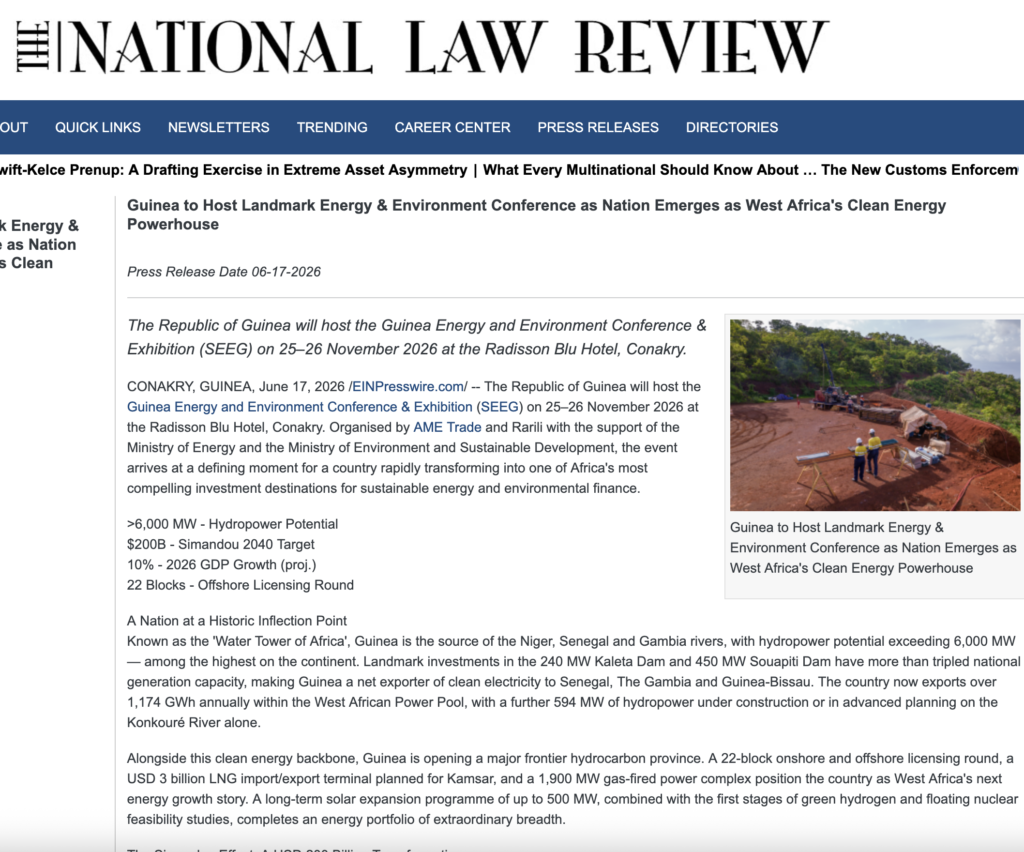
Known as the ‘Water Tower of Africa’, Guinea is the source of the Niger, Senegal, and Gambia rivers, endowing it with a hydropower potential exceeding 6,000 MW — one of the highest on the continent. The electricity access rate stood at 52% nationally in 2024, with commercial grid losses as high as 40% in 2025. However, landmark hydropower investments — including the 240 MW Kaleta Dam (2015) and the 450 MW Souapiti project (2022) — have more than tripled Guinea’s generation capacity, making it a net exporter of clean electricity to Senegal, The Gambia, and Guinea-Bissau. The country now exports 1,174 GWh annually within the West African Power Pool (WAPP) framework, and commercial losses are projected to fall to 20% by 2030 through grid modernisation and pre-paid metering — creating a compelling environment for private investment.
Hydropower — The Cornerstone of Guinea’s Energy Future
Hydropower will remain the dominant pillar of Guinea’s electricity mix, accounting for over 80% of total installed capacity. Three transformative projects on the Konkouré River alone represent over USD 3.8 billion in investment:
Project Capacity & Investment Status
Kaleta Dam 240 MW │ USD 526 million Operational
Souapiti Dam 450 MW │ USD 2.1 billion Operational
Amaria Dam 300 MW │ USD 1.2 billion Under Construction
Koukoutamba Dam 294 MW │ Feasibility Stage Planned
Khoumagueli Power Plant 25-year PPA signed 2021; construction from 2024 Planned
Solar Energy — Diversifying the Energy Mix
The Guinean government is diversifying its generation portfolio through utility-scale solar, with a long-term target of up to 500 MW of new capacity. Two 35 MW solar plants and one 30 MW plant in the Kankan and Siguiri regions are underway, with two additional 40 MW plants under discussion. Solar mini-grids for rural electrification create further opportunities for independent power producers and development finance institutions.
Oil, Gas & LNG — An Emerging Frontier
Guinea’s hydrocarbon sector remains largely underexplored, offering one of West Africa’s most compelling frontier investment opportunities. The government is finalising a 22-block licensing round covering both onshore and offshore acreage, supported by a National Seismic Data Visualization Centre developed with SLB and TGS. The USD 3 billion Guinea LNG project envisions a full-service import and export terminal at the Port of Kamsar, combined with a 1,800–1,900 MW gas-fired power plant to supply Conakry, the mining sector, and Simandou operations.
The Simandou Effect & Regional Integration
The Simandou iron ore project — the world’s largest untapped high-grade iron ore deposit — commenced first shipments in November 2025. The Simandou 2040 programme envisages USD 200 billion in mobilised investment over 15 years and is driving a surge in industrial energy demand, with alumina refineries planned for 2027–28 requiring large-scale reliable power. Guinea is also a cornerstone of WAPP: the Guinea–Mali electricity interconnection, backed by USD 372 million in multilateral co-financing, is under implementation from January 2026 to December 2028, extending Guinea’s reach as a regional clean energy hub.